The question travellers (and locals) are finally asking
Is the Saigon Metro actually worth using?
For years, it felt like one of those projects that existed more as a rumour than a reality — something people talked about, joked about, and half expected never to finish.
But then almost quietly…
Line 1 opened.
And for the first time, Saigon had a new rhythm running straight through it.
Quick answer: yes — it’s clean, calm, affordable, and genuinely useful
The Saigon Metro isn’t just a novelty.
It’s a real upgrade:
- fast
- organised
- air-conditioned
- and surprisingly easy as a family
And once you ride it, you start seeing the city differently.
Watching it take shape (2015–2024): the project that became folklore
For years, the Saigon Metro felt more like a conversation than a reality.
Back in 2015 and 2016, when we were living in the city, its earliest signs appeared as concrete pillars rising between buildings — out of place and unfinished.
Each visit after that brought more fencing, more dust, more speculation…
…but not much movement.
Progress was slow enough to become part of Saigon folklore.
Then, almost quietly, Line 1 opened.
Riding it for the first time felt strange in the best possible way.
A city we’d watched evolve for nearly a decade suddenly had a new rhythm running straight through it.
First ride, new perspective (Bến Thành Station)
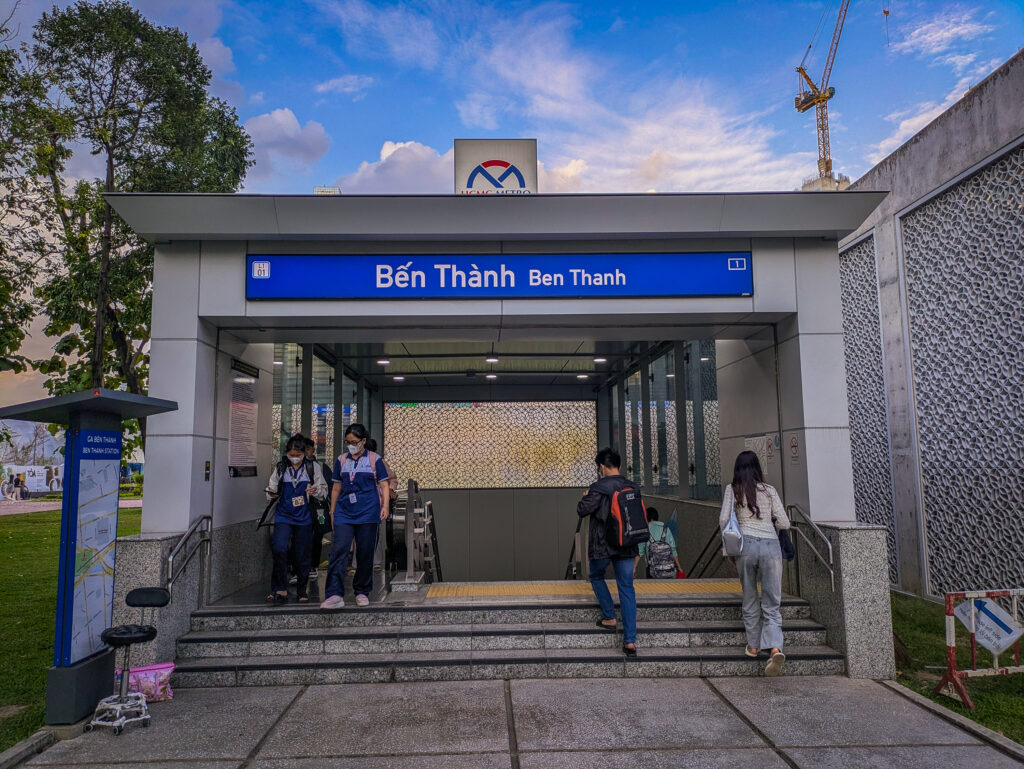
We started at Bến Thành Market, which now feels unexpectedly futuristic.
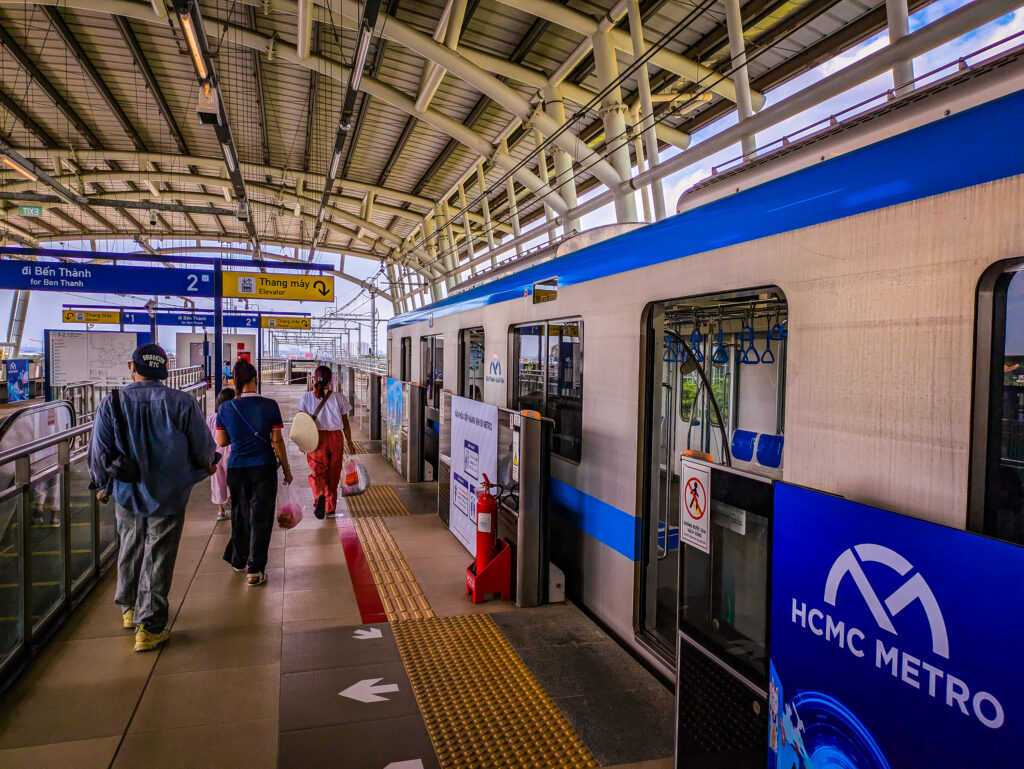
Long platforms. Bright lighting.
And a calm that doesn’t usually belong to District 1.
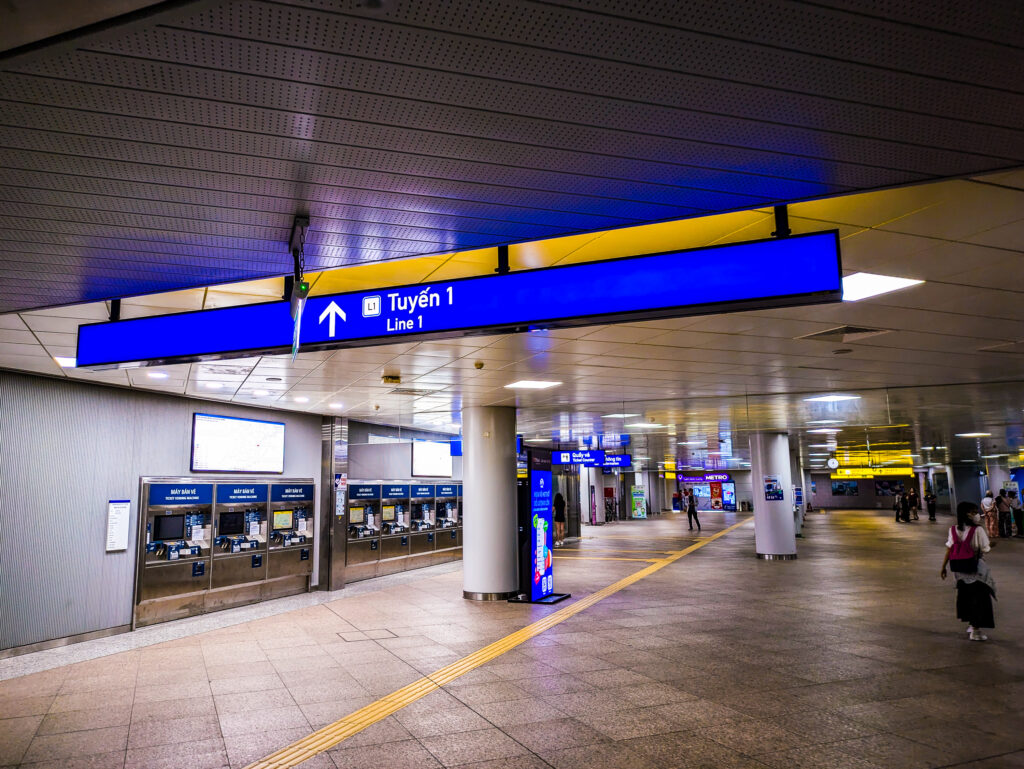
The ticket machines weren’t working that day — they normally offer Vietnamese and English — but there was no queue at the counter.
We bought three adult tickets, since children over 100 cm, including our seven-year-old, need their own.
Price: 20,000 VND per adult each way.
You scan to enter, keep the ticket for the exit, and trains arrive roughly every ten minutes.
What it feels like as a family
Travelling as a family adds its own choreography.
At the terminus, the train waits patiently, doors open.
Away from the end stations, stops are brief — maybe thirty seconds — and people move with purpose.
We kept our daughter close, hands held, especially during the evening rush.
Staff were always nearby, watching the platform, ready to hold the doors if someone needed an extra moment.
It made the whole system feel reassuring rather than rushed.
A different kind of movement (and a few useful rules)
There are small rules worth knowing:
✅ No eating on the trains (water is fine)
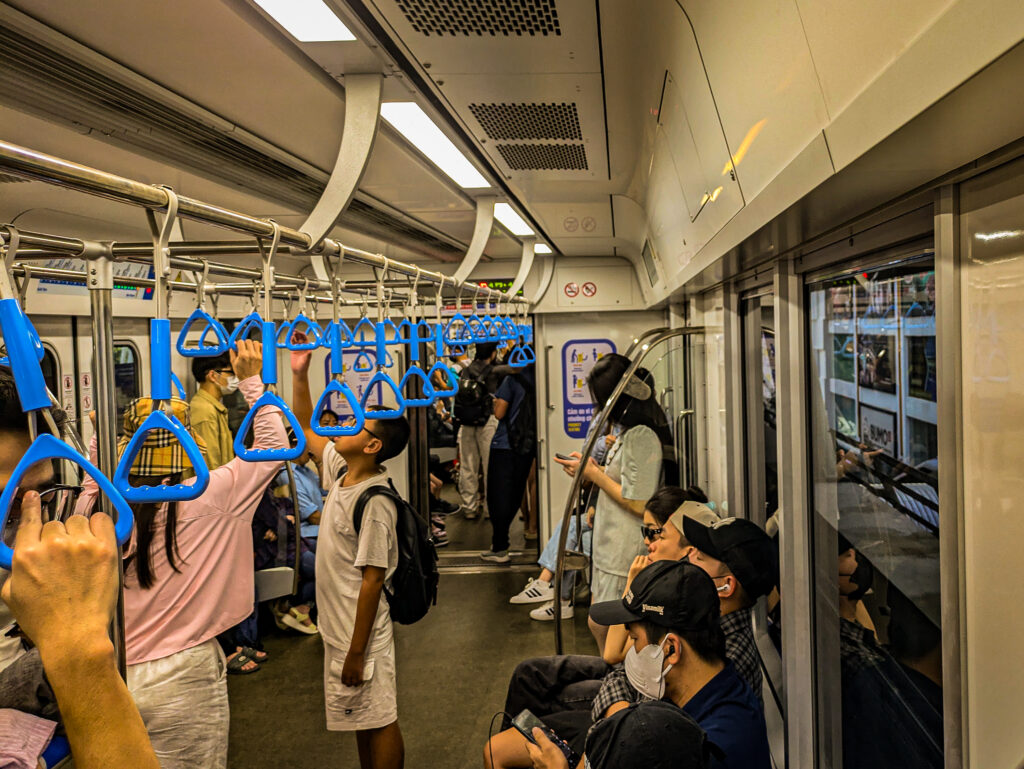
And the atmosphere is quiet.
Most passengers watch their phones or sit comfortably in their own space.
Stations are clean, orderly, and dotted with small vendors.
Everything feels composed — a sharp contrast to the motorbike energy below.
The moment Saigon opens up
Once the train leaves the underground section and crosses the Saigon River, the city opens beneath you.
From above, Saigon looks different — less tangled, more readable.
Traffic knots itself into slow queues below while the metro glides past effortlessly.
For a city powered by motorbikes, this gentle movement feels almost like seeing Saigon from the future.
Riding it end to end (Bến Thành → Suối Tiên Terminal)
We stayed on all the way to Suối Tiên Terminal, the final stop.
The entire journey took less than half an hour.
Fourteen stations passed quietly on the digital screen, each one hinting at future outings rather than destinations that day:
- Ba Son with its river views
- District 2 stops promising cafés and quieter streets
- university and tech park stations further east
- and finally, the stop for Suối Tiên Water Park
For now, we were happy simply watching the city slide by from a new angle.
The real game-changer: access (and the cost difference)
What the metro really changed for us wasn’t sightseeing.
It was access.
Bửu Long Pagoda in District 9 is an important place for my wife’s family — somewhere we visit every time we’re in Saigon.
The pagoda itself is peaceful and beautiful, with quiet courtyards, golden roofs, and a tall bell tower offering wide views over the surrounding area.
But getting there used to be unpredictable and exhausting.
On bad days, traffic swallowed ninety minutes each way, and the return taxi fare crept towards 1.5 million VND.
Now the journey feels simple.
Our new route (and what it costs)
✅ Return metro ticket from Bến Thành: 40,000 VND
✅ Grab from the terminus to the pagoda: ~56,000 VND each way
So for a family of three, the full trip comes to roughly:
230,000 VND total
And what once felt like an endurance test now takes about:
40–45 minutes
What used to be stressful has become a calm morning out of the city.


Final verdict: Saigon is still Saigon — but now it has a calm lane through it
After years of watching the metro slowly rise from the ground, the finished line feels almost effortless.
Clean. Quiet. Functional.
Saigon is still a city of noise and motorbikes.
But Line 1 offers something new:
- a way to move above the chaos
- to see familiar streets from a calmer angle
- and to reach places that once required patience and deep pockets
For those of us who waited so long to see it happen, the metro doesn’t feel like a novelty.
It feels like it belongs.
And that, somehow, makes all the waiting worth it.