What Does Saigon Feel Like at Street Level?
The sights are easy to list. Understanding how Saigon actually feels takes a little longer. Here’s what changed once we stopped trying to control the city and started moving with it instead.
What your first few minutes in Saigon really feel like
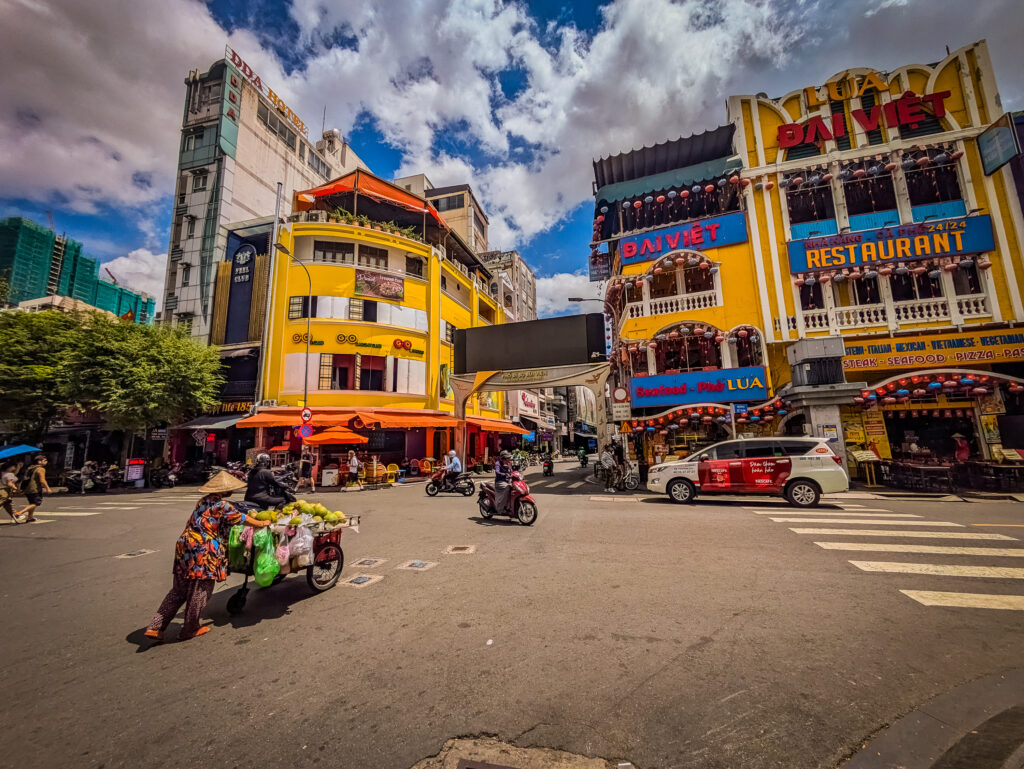
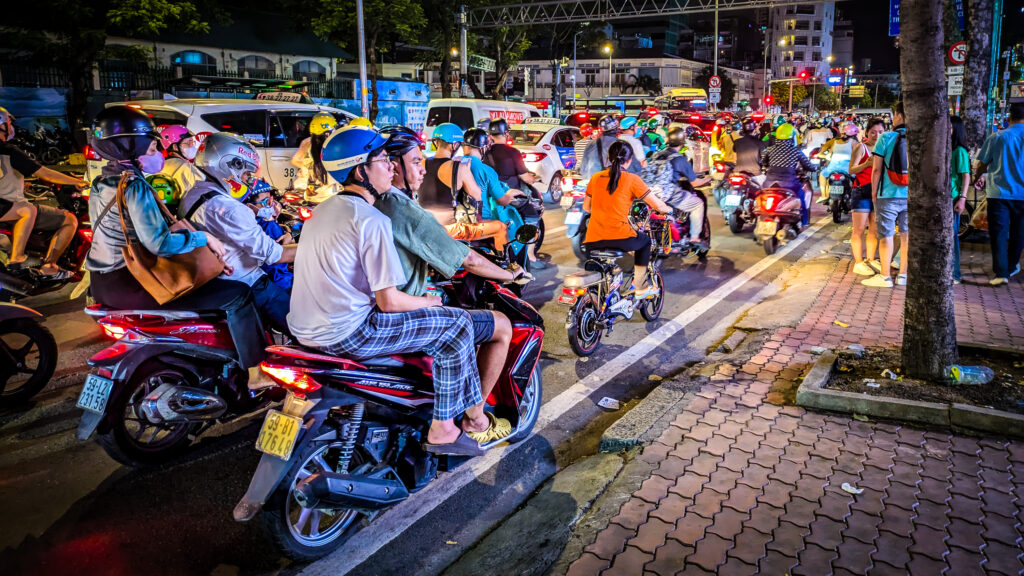
You step out into the evening heat in Saigon, running on very little sleep and just enough energy to reach your hotel. Within seconds, the city is asking more of you than you’re used to. Scooters stream past in every direction, horns overlap into one continuous soundtrack, and the warm, humid air feels heavier than it did inside the airport. At the same time you’re trying to work out which way to go, whether you’re crossing in the right place, and whether it’s worth stopping for food before checking in.
The first road crossing often becomes the moment when everything starts to feel overwhelming. You stand on the pavement waiting for a gap in the traffic, only to realise there isn’t one. Around you, local people aren’t waiting for the road to empty. They’re reading the movement, stepping forward at a steady pace and trusting the traffic to flow around them.
It feels completely unnatural the first time you do it yourself, but once you’ve crossed that first road something changes. The city hasn’t suddenly become quieter or less busy, yet it already feels more manageable because you’ve stopped expecting it to behave like home.
Looking back, that’s probably the first lesson Saigon teaches. The city doesn’t ask you to control it; it asks you to understand its rhythm. Once you stop resisting that and begin making small adjustments instead, everything that follows becomes noticeably easier.
✅ Quick answer
Saigon doesn’t feel chaotic because it’s disorganised; it feels chaotic because everything happens at once. The traffic, the noise, the heat and the pace all compete for your attention until you stop trying to control them. That’s usually the moment the city begins making sense, and it’s often when people realise why so many visitors end up falling in love with it.
The first evening that stuck (Turtle Lake, 2013)
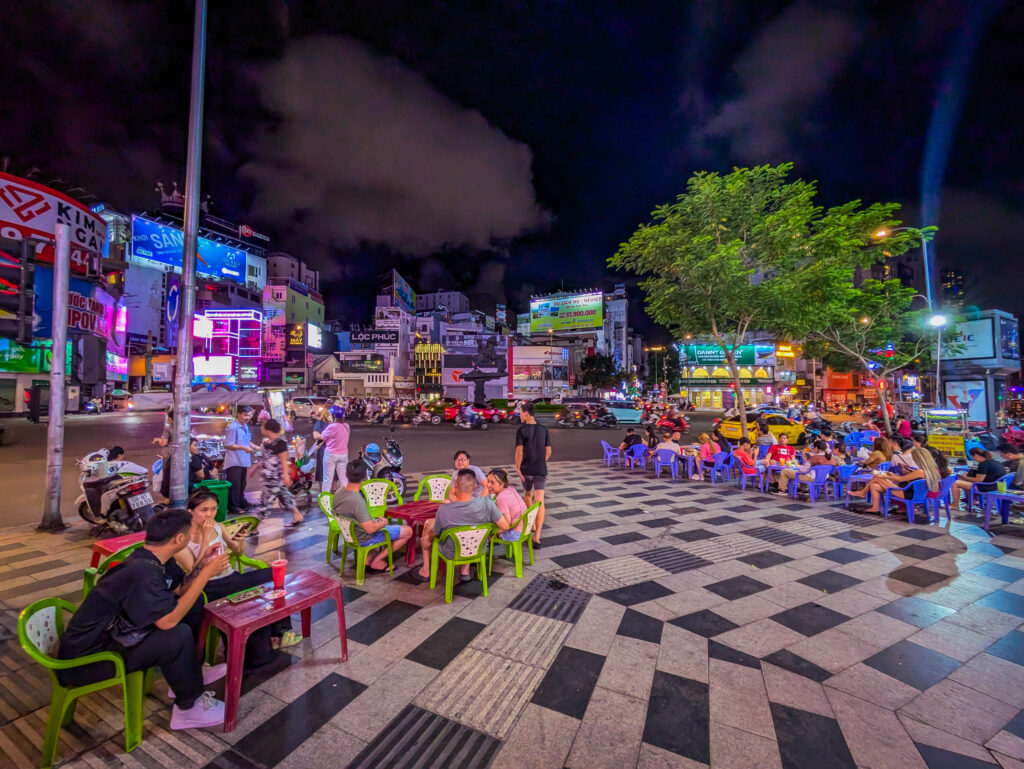
Mine happened in 2013, on my very first evening, standing near Hồ Con Rùa — Turtle Lake.
I’d just landed, exhausted after the journey and desperately in need of something familiar. Instead of diving straight into phở or bánh mì, I found myself looking for a burger and chips. Looking back, it had very little to do with the food itself. I simply wasn’t ready to make another unfamiliar decision after spending the best part of a day travelling.
That meal didn’t suddenly make me feel at home, but it gave me twenty quiet minutes where I could stop thinking, slow everything down and watch the city carry on around me instead.
Vendors grilled corn beside the lake while children circled the fountain and families gathered with drinks and snacks as the evening settled in. Every so often, the smell of dried squid drifted through the warm air, mixing with traffic fumes and conversations that I couldn’t yet understand.
Even through the jet lag, I remember thinking that this place felt different from anywhere I’d travelled before. It wasn’t trying to impress me or explain itself. Life simply carried on, whether I was ready for it or not, and somewhere during that first evening I stopped trying to understand every little detail and started enjoying the feeling of simply being there.e.
Learning the city’s soundtrack
One of the first things you notice about Saigon is that it has its own soundtrack. The city doesn’t just move; it constantly announces itself through voices, engines, music and hundreds of conversations taking place all around you.
Street vendors call out as they pass.
- “Bánh bao!” — soft, sweet steamed buns
- “Bắp xào đây!” — buttery corn mixed with dried shrimp
Ice-cream sellers announce their arrival with familiar jingles, while anyone who looks even vaguely like a visitor quickly becomes the focus of a cheerful “You! You! You!” from someone hoping to make a sale.
The first day or two, it can feel relentless because your brain treats every sound as something that needs your attention. Then, almost without noticing, you begin filtering it out. The calls become part of the background rather than a distraction, and instead of feeling overwhelmed by the noise, you start recognising it as part of the city’s personality. That’s usually another point where Saigon begins feeling less intimidating and much more familiar.
Where it pays to stay alert
Of course, settling into the city’s rhythm doesn’t mean switching off completely.
Outside places like the War Remnants Museum and Reunification Palace, it’s worth paying a little more attention. Coconut sellers sometimes quote tourist prices, and motorbike taxis can become expensive if you haven’t agreed the fare beforehand. These days we simply use Grab and remove the negotiation altogether.
None of this is unique to Saigon, and most visitors will never lose more than a few euro if they make the wrong decision. The bigger impact is usually on your confidence. A small mistake early in the day has a habit of making you question every price and every interaction afterwards, so a little awareness at the start often keeps the rest of the day feeling relaxed.
Where the city breathes
Once you’ve stopped trying to keep pace with Saigon, you begin noticing the places where the city slows itself down.
For me, that has always been Tao Đàn Park.
Since 2015, it’s been part of my routine. Back then, I walked through it on my way to work most mornings, and it quickly became one of those places that revealed a different side of the city. Men practised tai chi beneath the trees while bird cages hung from the branches above them, their owners sitting below with coffee and newspapers before the working day began. It was difficult to believe that only a few streets away, traffic was already building and thousands of scooters were beginning another day.
The atmosphere changes again in the late afternoon. As the heat begins to ease, the paths gradually fill with people taking slow walks beneath the trees. Teenagers stretch on benches, aunties gather for aerobics, children race between the playgrounds, and the small pagoda in the middle of the park quietly watches over it all.
Our daughter has loved Tao Đàn Park from her very first visit. There aren’t rides or organised activities competing for her attention. There’s simply room to run, explore and be a child for a while, which somehow feels far more valuable in the middle of a busy city.
A short walk away, Lê Lai Park offers something completely different.
During the summer, it often becomes an informal English classroom, with students approaching visitors to practise conversations they might never have the confidence to start elsewhere. Over the years I’ve lost count of how many times we’ve stopped for what was supposed to be a two-minute chat, only for it to become twenty minutes of laughter, questions and photographs.
The moment I mention that I used to live in Saigon, or that our daughter is half Vietnamese, the conversations almost always become more personal. Those small interactions rarely appear in guidebooks, but they’ve become some of the memories we talk about long after we’ve flown home.
Evenings that belong to families
As daylight fades, the atmosphere changes once again.
Nguyễn Huệ Walking Street becomes one of the busiest places in the city, but it never feels rushed. Children chase bubbles drifting across the square, dancers rehearse routines beneath the lights, and toy sellers launch glowing discs into the evening sky while parents stand back and watch with amused resignation.
By this point in the day, we’ve usually stopped trying to fit in one more attraction. Places like this don’t ask you to do anything except slow down and enjoy the atmosphere. Our daughter disappears into the crowds chasing bubbles or watching street performers, while we finally stop checking maps and wondering where to go next.
When we want a little more space, we usually take a short Grab ride across the river to Thủ Thiêm Riverside Park.
The skyline from here has become one of my favourite views of Saigon. Landmark 81 rises above the city, Bitexco catches the last of the evening light, and the towers of District 1 gradually begin glowing as darkness falls. Families spread picnic blankets across the grass, children fly kites in the open spaces, and conversations often pause for a few moments as everyone looks back across the river.
It’s one of those places where our daughter always seems happiest. She’ll wander a few steps ahead, completely comfortable in her surroundings, and I’m reminded that Saigon stopped feeling like somewhere we visited a long time ago. Somewhere along the way, it started feeling like a place we returned to.
Seeing everyday Saigon
Hidden between Nguyễn Thiện Thuật and Điện Biên Phủ, Bàn Cờ Market has become one of those places we always seem to find ourselves returning to. It isn’t because it’s famous or particularly photogenic. In fact, that’s exactly why we like it.
The narrow lanes are filled with fruit, vegetables, spices, clothes, household goods and countless food stalls, all carrying on with the business of everyday life. Nobody is trying to create an attraction or a cultural experience for visitors. People are simply shopping, catching up with neighbours and getting on with their day.
I’ve always enjoyed places like this because they tell you far more about a city than any landmark can. You naturally slow your pace, watch what’s happening around you and begin noticing the routines that local families probably don’t think twice about. It’s ordinary in the best possible way, and that’s exactly what makes it memorable.
A local favourite that still works for kids
Saigon Zoo has been part of the city since 1865, and although there are newer attractions across Saigon, we still find ourselves coming back whenever we’re visiting with our daughter.
Part of that is familiarity. It’s green, full of mature trees and provides welcome shade during the hottest part of the day, something every family quickly learns to appreciate in Saigon. Weekdays are usually relaxed, while weekends fill with local families enjoying a day out together.
What our daughter remembers, though, has very little to do with the animals. She talks about the little train, the playgrounds, buying an ice cream and having enough space to run around without us constantly telling her to watch for traffic. After spending the day weaving through busy streets, that freedom feels like a welcome change for all of us.
Moving through the city with kids
Travelling through Saigon with children hasn’t made us change everything we do, but it has made us pay much closer attention to the small things that keep the day running smoothly.
The heat builds surprisingly quickly, so we rarely head out without cold water, hats and a rough idea of where we’ll find shade if we need it. They’re simple habits rather than complicated planning, but we’ve learned that they’re often the difference between finishing the day happily or finding ourselves dealing with tiredness and short tempers much earlier than expected.
We’ve also found that some of the quieter side streets make the best places to pause for a while. Small family-run cafés, local shops and neighbours chatting outside their homes offer a chance to slow the pace before heading back into the busier parts of the city.
The only thing we’re consistently aware of is scooters. Not the busy traffic in front of you—that becomes surprisingly predictable after a while—but the occasional scooter approaching quietly from behind while you’re focused on something else.
A quick note about phones
Phone snatching does happen in Saigon, particularly close to busy roads, but it’s not something that dominates our thoughts whenever we’re there.
Like many large cities, a little awareness goes a long way. We keep phones close, step further back from the kerb if we’re checking directions and avoid standing beside the road any longer than necessary.
Those habits quickly become routine, and once they do, they’re rarely something you think about again. The aim isn’t to worry about what might happen; it’s simply to avoid letting a preventable mistake become the thing you remember most about your day.
Little things you remember (that become “Saigon” in your head)
Long after you’ve forgotten exactly which day you visited a particular market or café, it’s often the small details that stay with you.
Rain arrives without much warning in Saigon. One minute the streets are baking in the afternoon heat, and the next everyone is sheltering beneath awnings while warm tropical rain bounces off the pavements. Our daughter still groans every time a sudden downpour closes the hotel pool, while the scooters somehow continue weaving through the rain as though nothing has changed.
Then there are the power cables, hanging in tangled bundles above the streets. The first time you see them, you can’t help wondering how anyone could possibly know which cable goes where. After a while, though, they stop looking unusual and simply become part of the city’s character, much like the constant soundtrack of scooters and street vendors.
Looking back, those are the things I often remember first. Not individual attractions or famous landmarks, but the little moments that quietly become part of every visit. They’re the details that tell me I’ve stopped looking at Saigon as somewhere new and started recognising it as somewhere familiar.
✅ Four things that surprised us about Saigon
| What surprised us | What we learned |
|---|---|
| 🛵 The traffic rarely stops. | Crossing the road becomes much easier once you move predictably instead of waiting for a completely empty road. |
| 🔊 The city is noisy almost all the time. | After a day or two, the noise fades into the background, and you stop noticing it nearly as much. |
| 🌳 The busiest city often has the calmest parks. | Places like Tao Đàn Park slow the pace of the day, giving both adults and children time to recharge. |
| ❤️ Our favourite memories weren’t famous attractions. | Local markets, neighbourhood cafés and ordinary evenings became the moments we talked about most after returning home. |
What changed wasn’t the city
Looking back, I don’t think Saigon ever became easier. The traffic still moves with the same confidence, the streets are just as busy and the city still asks you to make dozens of small decisions every time you step outside.
What changed was me.
The first few days are spent trying to understand everything. Every road crossing feels unfamiliar, every sound competes for your attention and even deciding where to stop for lunch takes more thought than it should. After a while, those decisions stop feeling like decisions at all. You cross the road without hesitating, wander into a neighbourhood café because it looks inviting and find yourself taking a longer route home simply because something caught your eye.
When I think about Saigon now, I don’t immediately think about famous landmarks or attractions. I think about evenings at Turtle Lake, early morning walks through Tao Đàn Park, conversations with students in Lê Lai Park and watching our daughter disappear into the crowds on Nguyễn Huệ Walking Street as though she’d been doing it her whole life.
For me, that’s what this city has always been about. Not learning how to keep up with it, but learning to stop expecting it to work the way everywhere else does. Once that happens, Saigon stops feeling like a place you need to figure out and simply becomes somewhere you’re happy to be.